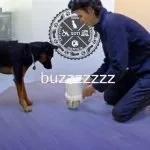
Desensitizing your dog to moving objects requires patience and a structured approach. Learn how to break down stationary interaction, sound, movement, and unpredictability so your service dog can remain calm and focused under threshold in any environment.
Most dogs, at some point in their development, will be over-interested in or even afraid of moving objects. Usually it is because the dog didn’t see or interact with many of these objects during their early socialization. They may also have been scared by an object during a fear period, and no desensitization was done soon after it happened.
For the purposes of this guide, an “object” could be a ball, balloon, bicycle, skateboard, shopping cart, car, vacuum cleaner, riding lawn mower, or garbage truck.
For safety and the confidence of your dog, always stay with your dog within leash length. Never leave your dog unattended (especially if leashed) when a human-operated object is in the area (with or without the human presence). There is too much risk of unknowing people making mistakes that can scar your dog.
Progress through the process at your dog’s speed. Always keep your dog under their threshold. It’s better to spend extra time on desensitization than to rush the process. Movement or sound can really set some dogs back, so don’t be in a hurry to combine them until your dog ignores both independently. Some triggers—like a fear of traffic—can take a long time (many sessions or months) to truly overcome.
A. Smelling & Touching the Object
Start with the object completely stationary at a distance where your dog is well below threshold. Work closer in small increments until your dog is within nose-touch reach.
Sometimes, you may need to approach the object directly. For example, if your dog is focusing on a strange-shaped rock, it might be better to walk directly to it and touch it yourself, then let your dog interact with it. Role modeling calm behavior and touching the object can help many dogs. With a noisy or dangerous machine, however, it is better to take a slower, indirect approach.
Other times, it is better to slowly move toward the object and click/treat (C/T) for any calm behavior and focus on you. When you arrive, allow your dog to interact with it: sniff it all around (approaching from various angles), nose and paw target it, push it, or stand on it—whatever is appropriate for that object, your dog’s physical safety, and the surrounding environment.
Follow these progression steps near the stationary object:
- Simple Cues: When your dog is able to stand or sit calmly nearby, try requesting simple cues—nose touch, paw touch, glance at you, or sit—that your dog does easily or enjoys. Click and treat for attempts and good responses.
- Play: Engage in play with a toy near the object.
- Complex Tasks: Ask for more complex behaviors—downs, short recalls, heeling, longer duration eye contact, and appropriate service tasks.
You can now add distance. Hopefully, your dog will be satisfied that she knows what the object is, will ignore it, and will respond to your cues. If she does not, keep working her near the object or approach other similar objects in the same way in different locations. Your dog should soon generalize that the object is just an object, no matter where you are, and not worthy of special interest.
B. Hearing the Object
Add distance again to find your dog’s threshold for the sound, working comfortably below it. Have a helper make the object produce sound while staying stationary (e.g., a bicycle bumping over gravel, brakes squeaking, or turning on a motorized object while parked).
- Move closer to the object as your dog becomes comfortable with the sound.
- Request simple cues (nose-touch, paw touch, sit) that your dog enjoys.
- Play with a toy near the sounding object.
- Progress to more complex behaviors and service tasks.
Add distance again to verify that your dog ignores the sound and responds to your cues. If not, continue working near the sound or approach other similar-sounding objects in different locations until she generalizes the sound.
C. Watching the Object Move
Start at a safe distance and ask a helper to move or drive the object at a very slow speed. Increase the speed gradually as your dog handles it. When your dog can handle the object passing by while deferring to you, run through the standard progression: simple cues, toy play, and then complex service tasks.
When moving closer to the object, you should move toward it first, as it may trigger interest or fear. You want your dog to feel she has a choice in approaching or moving away from the noisy, moving object. This gives her a sense of control and confidence.
If at any time she wants to move away, retreat with her to just below her threshold distance. When she is comfortable, focused, and carrying out simple cues, direct the helper to move the object in stages:
- Parallel to your dog
- At an angle relative to your position
- Moving more directly toward you and your dog
Progress slowly and stay under threshold to build success. At each step, start with simple cues, progress to playing, and finish with complex behaviors.
D. Unpredictability
Once your dog is comfortable with predictable movement, ask your helper to be less predictable when operating the object—driving past, coming toward the dog, speeding up, or slowing down unexpectedly.
- Cue several simple, high-enjoyment behaviors (nose touch, paw touch, sit).
- Play with a toy.
- Ask for complex behaviors and service tasks.
- Move toward or away from the object as needed to support your dog’s success. Always reward for staying focused and completing tasks!
E. Generalizing to Other Locations
Just because your dog is comfortable with an object in one location does not mean they will automatically accept it in another. You will need to deliberately set up situations where you encounter the object in new environments.
Be ready for a active training session as needed. Always decrease your criteria whenever you introduce a new variable (such as faster speed, louder sound, or a novel environment).
- 5 Locations: Repeat training in at least 5 different environments to ensure your dog begins ignoring the distraction anywhere.
- 10 Locations: When your dog remains non-reactive across at least 10 distinct locations, they have likely put their over-sensitivity to that specific object behind them.
Be aware that if you encounter a similar object that is closer, louder, or moving faster than what you’ve trained for, your dog may still react and slide backward in the desensitization process. If that happens, simply return to earlier steps in the progression and let your dog guide how quickly you move forward again.
Can you see the pattern you are building here?