
SDTI Monthly Newsletter
March 2026 Edition
 Get future newsletters in your RSS reader
How Dogs Learn: Teaching with Principles Part 2 of 3 How Dogs Actually Learn
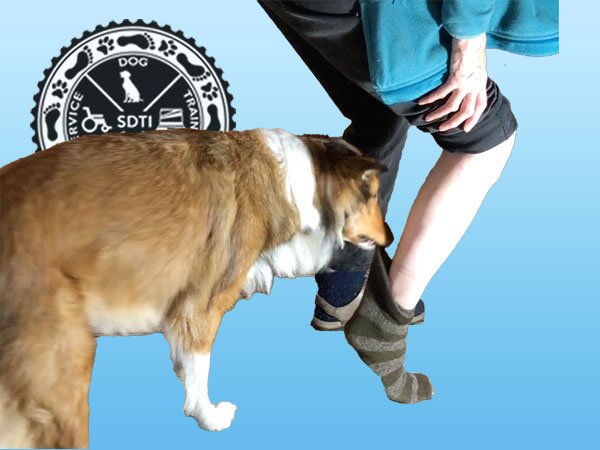
In Part 2, we are looking at application of the science behind the learning principles. This is something every service dog handler and trainer should know as they help you to figure out how to train anything!
Featured Resource This Month
Highlighted SDTI Courses
This month’s special offer is 25% off the following online classes that deal with training skills:
- (3) Targeting and Luring
- (5) Shaping
- Hand-Delivered Retrieve
ACCESS
24/7 for 2 years
FORMAT
Self-study
Mini Quiz Challenge
According to the Matching Law, your service dog jumps on visitors 6 out of 10 times to get attention, and sits politely for attention 4 out of 10 times. Why does your dog keep jumping despite your training efforts?
A) Your dog is being stubborn
B) Your dog forgot the “sit” cue and needs more practice
C) Jumping pays better—it works 60% of the time while sitting only works 40% of the time (Bruce: correct answer-remove when color added)
D) Your dog is too excited to remember their training
Did You Know?
That you can use activities your dog already loves as reinforcement for training? The Premack Principle means “first you do this, then you get to do that”—like using the opportunity to greet a friend as the reward for walking calmly on leash.
That switching from continuous to variable reinforcement actually makes behaviors stronger and more persistent? Once your dog knows a behavior well, rewarding unpredictably creates more reliable performance than rewarding every single time.
That classical conditioning is happening constantly whether you plan it or not? Your keys predict car rides, your vest predicts work, and your breathing changes predict medical episodes—your dog is forming these associations automatically.
That the effectiveness of any reinforcer depends on your dog’s current state? Food works best when your dog is hungry, play works best when they’re energetic, and calm reinforcers like massage work best when your dog is already in a calm state.
Featured Resources
Free Blog Post: The Science of Training – Part 2 How Dogs Actually Learn
You understand your dog as a whole being now—their emotions, their biology, their social nature. You know that a stressed dog can’t learn, that one bad experience can create lasting fear, and that your own emotional state affects your dog’s ability to focus.
But understanding your dog’s internal world is only half the equation. Now it’s time to learn the mechanics: How does learning actually happen? What makes a behavior stick? Why does timing matter so much? And how do you build complex service dog tasks from the ground up?
Video: Service Dog Task: Flipping a Light Switch
Shaping using tiny steps is a key principle in teaching a dog. Follow Jessie’s actual progress during the first steps learning to turn on a light switch. In under 4 minutes (approx. 45 clicks), she has the main idea.
Paid Blog Post: Teaching Handlers to Apply Principle- A Guide for Service Dog Trainers Part 2A
You’ve just finished explaining the Yerkes-Dodson Law to a new handler. They nod enthusiastically, saying they understand completely. Then next session, they show up having practiced for an hour in a packed PetSmart with their anxious 4-month-old puppy because they wanted to “get her used to distractions early.”
Understanding principles intellectually and applying them in real-time are two very different skills. As trainers, our job isn’t just to teach handlers what the principles are—it’s to help them recognize these principles in action and respond appropriately in the moment.
Paid Blog Post: Teaching Handlers to Apply Principles- A Guide for Service Dog Trainers Part 2B
The Challenge
Handlers want the final behavior immediately. They get frustrated when the dog doesn’t perform perfectly and don’t understand how to break behaviors into trainable pieces. They also struggle with the concept of thinking in “snapshots” of behavior.
Your Coaching Approach
Teach the “snapshot” concept and backward planning: Think of shaping like a series of photos of a behavior from start to finish. Each photo is a step toward the final behavior. You reward after each snapshot in the right direction.
Paid Blog Post: Teaching Handlers to Apply Principles- A Guide for Service Dog Trainers Part 2C: Teaching Generalization, Memory, and Integration
Handlers think “trained is trained” and don’t understand why their dog “forgets” behaviors in new contexts. They don’t realize that cues need to generalize across all the contexts where they’ll be used.

Training Tips
Marker Training is an Effective Way to Communicate with your Dog
Use marker training (clicker, verbal “yes” or other sound) to capture the exact moment of correct behavior. This allows you to mark precise parts of behaviors even if the delivery of reinforcement takes a few extra seconds. It’s amazing how many behaviors a dog can do in just a few seconds! This way, it’s clear to your dog which behavior you are looking for.
Shaping behaviors
Think of shaping like a series of snapshots from start to finish. Reward each small step in the right direction, only moving to the next “snapshot” when your dog succeeds 80% of the time at the current one. If the behavior is a small one, then 5 “snapshots’ might all that is needed. A medium behavior might need 10 steps and a complicated one might need 20! Break challenging spots of the behavior into as many smaller steps as your dog needs. This increases speed of success and reduces frustration for your both.
One change at a time
Change only ONE variable at a time when building new behaviors or changing old ones. Don’t increase duration AND distance AND distractions all at once—your dog will struggle. Adjust one thing, master it, then teach the next alone, before doing them together. Do this for each criterion of the behavior too.
Matching Law
When a behavior isn’t what you want in a situation, do a “reinforcement audit.” Track what’s actually functioning as the reinforcer in your dog’s daily life—often the unwanted behaviors are still paying better than the behaviors you’re trying to train. What is really is the reinforcer for your dog? Social interaction from another dog or person? Sniffing something exciting? The chance to chase something fun? That’s why the behavior isn’t changing despite your best training effort.
Events This Month
FREE QA Chat
Date: Sat. March. 14 at 1:00PM Pacific
Topic: How to Transfer Cues to Others (Family Members, Helpers etc)
So your dog has learned the behaviors with you! But he can’t do them for other people close to you! Find out how to transfer learned cues to make it easy for your dog and the new person. Bring your questions, share your experiences. Meet the community!
The QA Chat will be recorded and added to the library so if you cannot attend, it will be available. At just CA$11 per month (~US$8.10), it’s a great way to support us. Sign up for a day, get access for the month. Cancel anytime!