
SDTI Monthly Newsletter
January 2026 Edition
 Get future newsletters in your RSS reader
Jan 2026 -Connecting with Cues
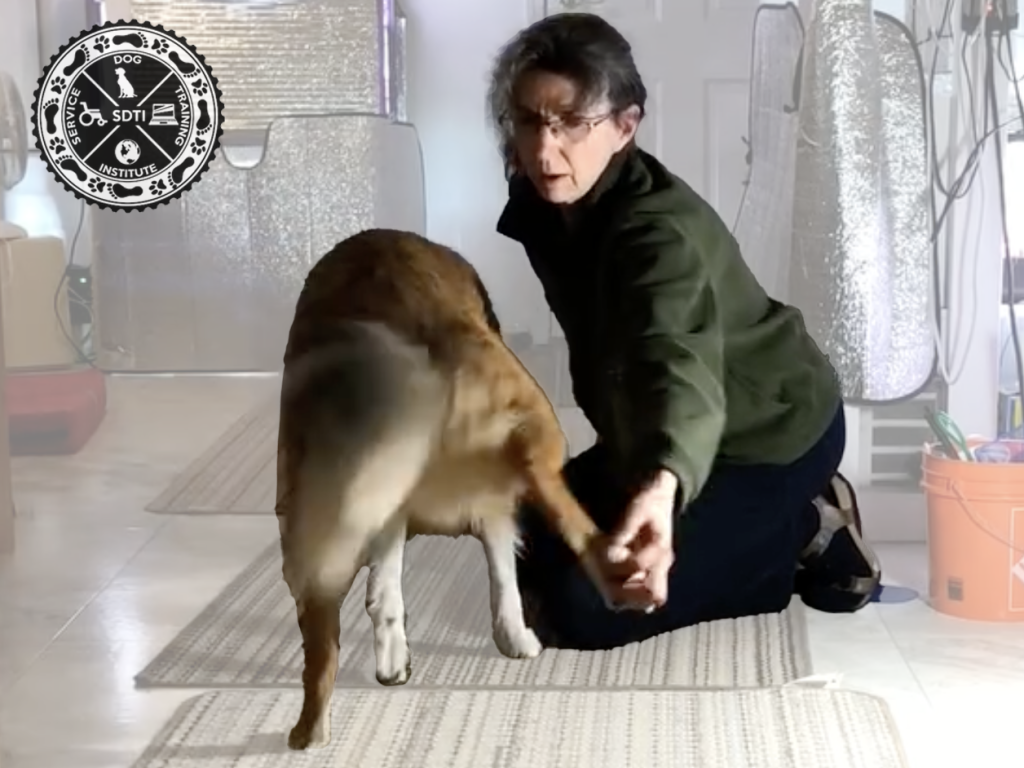
Start the New Year out right with good communication with your service dog! Discover how cues work, how to proof and test them.
Featured Resource This Month
All SDTI Courses
This month we are offering 25% off all course regular prices (including bundle deals).
(Library subscription and webinars not included)
ACCESS
24/7 for 2 years
FORMAT
Self-study
Mini Quiz Challenge
Which of these are NOT true about using cue with a service dog?
A) Cues may be obscured by sounds or motion in the environment.
B) Cues function the same as commands.
C) Learning what cues are and how they function is learned as concept.
D) Cues can start, stop or continue behaviors.
Did You Know?
Cues are: a signal to your dog to do a behavior or task. They are different from a command in that the dog always has choice in whether they do the behavior or not. You get reliability with practice and setting up motivators so the dog chooses to do a behavior and it becomes a habit out of association. (Think Pavlov’s tone and drooling) so the dog doesn’t think about it, it just reacts to it.
“Cues” are often confused with “Queues” which are line ups of people or vehicles etc.
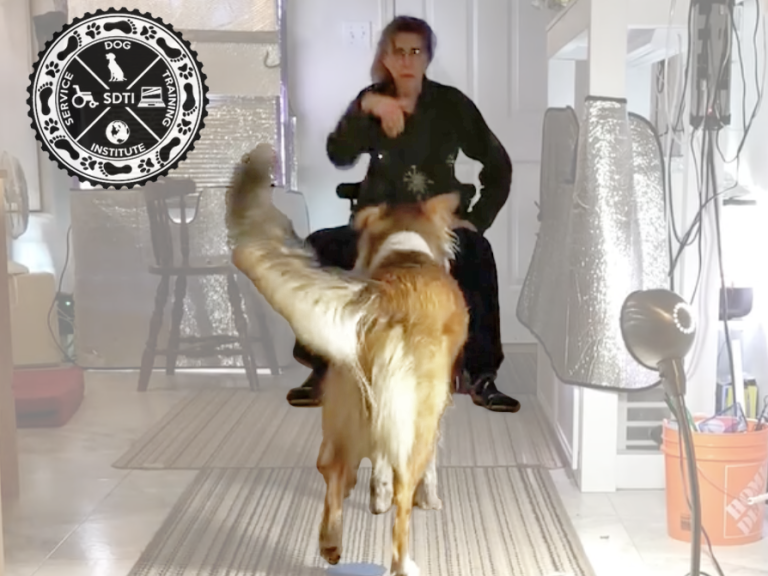
Cues may be a sound (word), hand signal, body motion, piece of equipment, object, scent or combination of things in the environment.
You can use any cue that works for you and your dog. Any word, hand signal, body movement can be used for any behavior. There is no standard cues for any behavior or task. People think there are because programs that have multiple trainers for multiple dogs often standardize their use for consistency and clarify of use. It’s your dog, and your choice. The key is to use the same cue for the same behavior.
You can teach several different cues for one behavior but not use the same cue for different behaviors.
You can change a cue from an old one to a new one by presenting the new one first, then immediately give the old one then mark when the dog does the behavior. With many repetitions and when you see that your dog starts to respond to the new cue right away, you can slowly fade the old cue.
A dog’s natural preference is for body and motion-related cues. They are very good at observing movements. Their eyes are structured for this. Some breeds have been bred to respond well to sounds like whistles and verbal cues. Not all individuals have this ability.
Featured Resources
Video: Adding a cue to a behavior
Learning how to add a specific cue to a specific behavior is easy! The hard part is generalizing it.
Video: Proofing
One often-missed step is proofing a cue. Find out how to use position changes to see if your dog really understands your cue.
Video: Testing if Your Dog Really Understands Your Verbal Cue?
Here is how to train and test to see if your dog really does understand specific words for specific behaviors. Of course, you can do set ups to test if your dog also responds to other types of cues as well.
Free Blog Post: When Your Service Dog Finally Gets It: Understanding Cues as Concepts
You know that magical moment when your dog suddenly seems to “get” training? Like a lightbulb switches on and they start picking up new behaviors faster than you can think of them? That’s not magic—that’s your dog understanding cues as a concept. And it’s one of the coolest things that happens in dog training.
Paid Blog Post: Helping Students Choose Clear, Functional Verbal & Body Cues for Their Service Dogs
As service dog trainers, we’re not just teaching dogs—we’re teaching handlers how to teach their dogs. One of the most overlooked (and most fixable) friction points in a team’s progress is cue selection. Poorly chosen verbal or body cues can quietly undermine learning, create confusion, or limit a handler’s long-term success. Thoughtful cue selection, on the other hand, supports clarity, confidence, and independence for both members of the team.
Training Tips
Choose Cues That are Distinct From Each Other
When choosing cues, it’s a good idea to plan ahead of time which ones you will use for behaviors you use often.
With verbal cues, words that use the same vowels may be difficult for a dog to tell apart, especially in noisy environments. Go, Slow & Tow all sound similar but have different meanings. Consonants can be difficult to tell apart. The subtle differences between B, P and D can be missed in Bop and Pop.
The same applies to hand cues. Make sure that you are using very different motion (how you hold your hand, turning your hand, pointing etc) to avoid confusion.
Chaining
We can use stringing several cues together to increase the amount of work a dog will do through “chaining”. The cue for the second behavior acts as both a marker and reinforcer for the first behavior. You can string several together. Putting several of the same cued behaviors together increases duration (like steps beside you in loose leash walking). You can also put several different cued behaviors together to get more complicated behaviors (like a retrieve) that people often consider a single skill.
Stimulus Control
In order to have your dog perform a behavior reliably and when you need it, you need to teach the cues to “stimulus control” in a training session.
There are four criterion a cue must meet to be considered under “stimulus control”.
- The behaviors occurs immediately after the cue is given.
- The behavior doesn’t happen without the cue.
- Other cues don’t trigger the behavior to happen
- No other behavior occurs in response to the cue
Poisoned Cues
When a dog makes an unpleasant association with a cue, it is called a “poisoned cue”. This means the dog may show reluctance to do the behavior, or not do it at all. It may look like the dog is being “stubborn” or is even fearful of the cue. Poisoned cues often happen unintentionally in training when something happens in the environment or the handler does something that is aversive to scary for the dog right after giving a cue. An extreme case might be right after a dog is given a cue and a car backfires close by. To the dog, the cue became a prediction of the loud scary sound in that single event. An object falling on or near the dog right after a cue is given is another situation. More common and lesser intensity events can also trigger a dog to be reluctant to do a cue. A dog that is experiencing mild arthritis is asked to jump into a vehicle from a slick floor, the “jump” or “in” cue becomes poisoned as it hurts. Even during a training session, a frustrated handler may make an automatic sound like “Uh Uh” when their mouthy dog grabs an object too hard or in the wrong way. The dog associates the handler’s sound with the cue to retrieve rather than his own behavior. The dog is likely to refuse to do anything with the object. Events like these happen and they are a good reminder to be very aware of movements, sounds and habits that happen near the dog during training. If you are finding this happen in your training sessions, video several sessions and watch for the timing of any uncomfortable event. Once you have identified them, you can change your approach with your dog.
Fortunately, poisoned cues can be fixed by retraining a behavior from the beginning and teaching a new cue to the behavior without associating the old poisoned cue. Often using a different approach to training or in a different location than where the event occurred can help the handler to avoid the same pitfall.
Events This Month
FREE QA Chat
Date: Sat. Jan. 10 at 1pm Pacific
Topic: Cues, Cues and More Cues!
Find out how other handlers use cues creatively and that work with their disability. Bring your questions, share your experiences. Meet the community!
The QA Chat will be recorded and added to the library so if you cannot attend, it will be available. At just CA$11 per month (~US$8.25), it’s a great way to support us. Sign up for a day, get access for the month. Cancel anytime!